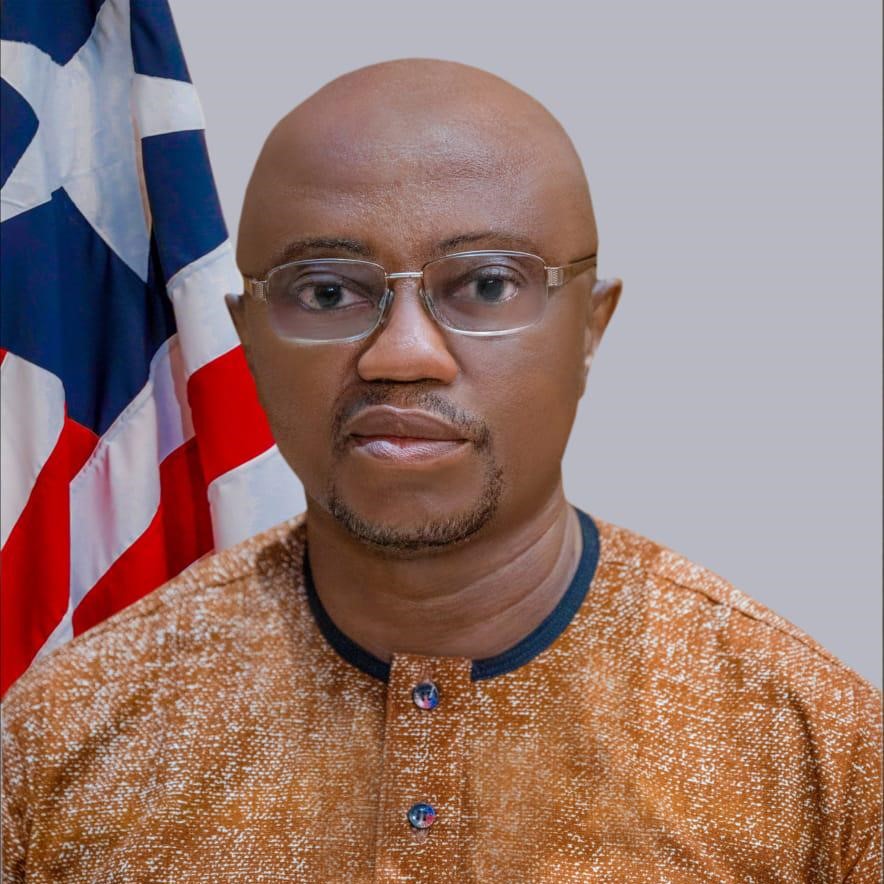
Cllr. Lamii Kpargoi
Lamii Kpargoi is a lawyer who currently serves as a Commissioner of the Office of the Ombudsman of the Republic of Liberia. Before joining the Ombudsman, he served briefly as the Executive Director of SAWABENU, a rule of law advocacy NGO founded by former staffers of The Carter Center.
From 2017 to 2019, he served as a Program Officer in The Carter Center’s Access to Information Program in Liberia. From 2020 to 2023, he served as a Senior Program Officer in the Center’s Rule of Law Program. For 11 years, from 2006 to 2017, he worked for the Liberia Media Center in various capacities, leaving the organization in 2017 after serving as its head for five years.
Cllr. Kpargoi is a 2019/2020 recipient of the highly competitive Chevening Scholarship from the Government of the United Kingdom. In 2015/2016, he became one of only four Liberians, to date, to be awarded the prestigious Reagan-Fascell Democracy Fellowship by the National Endowment for Democracy in Washington, D.C. In 2011, he was among the first cohort of US State Department Community Solutions Fellows. As a Community Solutions Fellow, he worked at the Voice of San Diego newspaper, where he did a weekly poll of mayoral candidates for the city’s mayoral race.
He is a Joseph Jenkins Roberts Educational Foundation (JJREF) scholar and served as president of the Joseph Jenkins Roberts Scholarship Students Association (JJRSSA) between 2002 and 2004. He was awarded the JJREF Scholarship Award for Academic Excellence in 1995 as a senior at Monrovia College and Industrial Training School in Monrovia.
In 2006, Cllr. Kpargoi earned a Bachelor of Science degree (cum laude) in Electrical Engineering from the University of Liberia. In 2010, he graduated from the Louis Arthur Grimes School of Law with an LLB and was called to the Bar of the 5th Judicial Circuit, Grand Cape Mount County, in February 2011. He also holds an LLM in Labour Law and Corporate Governance with distinction from the University of Bristol in the United Kingdom. Lamii Kpargoi is licensed to practice law at the Supreme Court of Liberia.
He has authored several publications and opinion pieces on the media and governance, including Opinion and Attitude Study on Access to Information, Media Consumption & Communication Environment in Liberia, as well as IREX’s Media Sustainability Index Liberia chapter. During his time as a Reagan-Fascell Democracy Fellow at the National Endowment for Democracy, Cllr. Kpargoi examined how freedom of information legislation is implemented in the United States to strengthen public access to information in Liberia.
Cllr. Kpargoi is known for his dedication to upholding democratic values, promoting press freedom, and advocating for human rights. With many years of experience in the legal and media sectors, he has played a pivotal role in strengthening civil society and advocating for transparency and accountability in Liberia’s governance processes.
In 1986, six years after the Brownell Committee’s recommendations, Liberia adopted a new Constitution. Article 90 of this new Constitution prohibited public officials from engaging in activities that would create conflicts of interest, mandating the Legislature to establish penalties and prohibitions for such misconduct. This provision was a pivotal step toward codifying ethical standards for public servants, embedding these principles within Liberia’s legal framework. However, despite this mandate, progress in developing a comprehensive Code of Conduct and an operational oversight body remained stagnant for nearly three decades.
After 28 years of advocacy and legislative deliberation, Liberia passed the Code of Conduct Act in 2014 during the Presidency of Africa’s first female democratically elected President. This Act established the Office of the Ombudsman as an independent oversight body, charged with enforcing ethical standards across government institutions and private actors institutions. The Code sought to uphold principles of transparency, accountability, and integrity in public service by defining acceptable conduct for public servants. Despite the formal establishment of the Ombudsman’s Office in 2014, as the administrator of the Code of Conduct, it remained largely inactive due to delays in appointing essential leadership and securing operational resources.
To enhance the functionality of the Code of Conduct and the operation of the Office of the Ombudsman, two key amendments were made to the Code of Conduct. The First Amendment in 2017 provided a detailed operational framework for the Office, outlining its structure, mandates, responsibilities and transferred specific administrative duties to Liberia Anti-corruption commission on asset declaration and the National Elections Commission (NEC) to handle elections related ethical matters. The Second amendment of 2022 shortened the mandatory resignation period for public servants seeking elective office from two years to one.
To enhance the functionality of the Code of Conduct and the operation of the Office of the Ombudsman, two key amendments were made to the Code of Conduct. The First Amendment in 2017 provided a detailed operational framework for the Office, outlining its structure, mandates, responsibilities and transferred specific administrative duties to Liberia Anti-corruption commission on asset declaration and the National Elections Commission (NEC) to handle elections related ethical matters. The Second amendment of 2022 shortened the mandatory resignation period for public servants seeking elective office from two years to one.
After years of stalled progress, the Office of the Ombudsman was finally operationalized in August 2024. Newly elected President Joseph Nyuma Boakai, Sr. demonstrated a strong commitment to ethical governance by appointing key leaders to bring the Office to life. On April 5, 2024, Cllr. Finley Y. Karngar was appointed as Chairperson of the Office, with Cllr. Lami Kpargoi and Atty. Etmonia Martin was named as Deputy Ombudsman subsequently. These appointments marked a transformative moment, signifying Liberia’s readiness to enforce its Code of Conduct and promote diligence and discipline corps of public servants at all levels of governance.
As Liberia commemorates 45 years since the concept of a public policy framework for conflict-of-interest prevention was first proposed, the operationalization of the Office of the Ombudsman under Chairperson’s represents a milestone in the country’s pursuit of ethical governance. The Office is now poised to uphold ethical standards through independent oversight, transparent processes, and accessible complaint mechanisms to contribute to public trust building for government functions…”the establishment of the Office of the Ombudsman symbolizes Liberia’s commitment to addressing longstanding governance challenges. With its foundation now firmly in place, the Office stands as a guardian of integrity and accountability, ushering in an era where ethical governance is rigorously enforced across all levels of public service, strengthening public trust in Liberia’s democratic institutions”.